In this article
- The Short Answer: Two Different Jobs That Work Best Together
- What Physical Therapy Covers in Parkinson's Care
- What a Parkinson's Boxing Coach Covers
- Parkinson's PT vs. Exercise Coach: How Goals and Methods Differ
- When to See a Neuro Trainer vs. a Physical Therapist First
- Combining PT and Boxing for Parkinson's Without Overlap
- Choosing a Parkinson's Boxing Coach: What to Check Before You Start
- Frequently asked questions
Parkinson's changes how you move, and it changes who you turn to for help. Sooner or later, most people I work with ask the same thing about a Parkinson's boxing coach vs physical therapy: which comes first, and do I need both?
I'm Jeff Battenberg, a 6th-degree black belt and neuro-training specialist, and I founded Texas's first Rock Steady Boxing affiliate. I coach. I don't replace your therapist. This guide lays out what each role covers, where they overlap, and how to decide with your care team.
The Short Answer: Two Different Jobs That Work Best Together
Start with a physical therapist when your movement has changed. Add a Parkinson's boxing coach once your mobility is stable and your medical clearance is in hand.
Many of my clients use both in sequence. Therapy gives them a clinical baseline and a safe home program, and coaching builds skill, rhythm, and confidence on top of that foundation.
The two jobs are different because the questions are different. A therapist asks what is happening in your body and how to make it safer. A coach asks what you can build next, and how to keep you training week after week.
Neither one replaces the other, and neither one is a cure.
What Physical Therapy Covers in Parkinson's Care
Physical therapy is the clinical route for evaluating and treating movement problems. A therapist assesses your gait, balance, transfers (getting out of a chair or bed), and fall risk, then writes a plan of care with specific goals.
Most plans also include home programming, so the work continues between visits. Some therapists use clinician-led approaches such as LSVT BIG, a program that targets larger, higher-amplitude movement.
If you are choosing a therapist, look for one with real Parkinson's experience. The Neurologic Clinical Specialist (NCS) credential is one marker worth checking, though it is not the only sign of a good fit.
PT is goal-based, and it is usually episodic. You work toward defined targets, you reach them or plateau, and the plan of care ends. That is how it should work. It is also why so many people finish therapy and then wonder what comes next.
Where Physical Therapy Adds the Most Value
PT matters most when something has changed and nobody has yet explained why. A therapist can sort out whether a new stumble comes from weakness, a freezing episode, a medication pattern, or something unrelated to Parkinson's.
It also matters after surgery or a hospital stay, and whenever pain starts altering how you walk. A coach is not equipped to evaluate those situations, and you shouldn't ask one to.
If you want a therapist to teach you strategies for a specific problem, such as turning in tight spaces, PT is the better tool. That kind of targeted problem-solving is a clinical skill.
What a Parkinson's Boxing Coach Covers
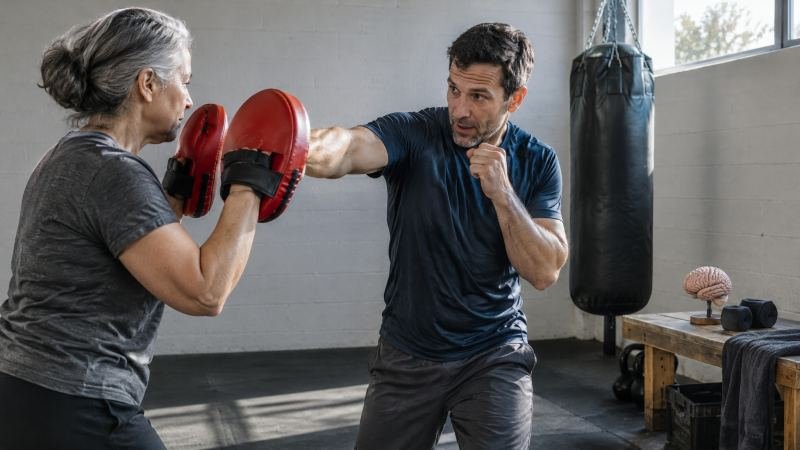
A Parkinson's boxing coach, sometimes called a neuro trainer, provides skill and conditioning work. The focus is footwork, rotation, rhythm, reaction time, and cross-body coordination, delivered in a structured, coached session.
Let me be plain about the limits. A coach does not diagnose, and a coach does not treat. If your concern is a medical one, it belongs with a clinician.
The format has a public history worth knowing. Rock Steady Boxing, a non-contact program built for people with Parkinson's, began in Indianapolis in 2006 and remains the best-known model of a boxing-based class for this population.
Outcomes deserve careful wording too. Research on boxing-based training for Parkinson's is still largely small-scale, so I describe the results as promising rather than proven. What I can tell you is what I see: clients who show up consistently, move with more confidence, and talk about daily tasks differently.
The Training Pillars Behind the Drills
My work is assessment-driven, which means I look at how you move before I decide what to train. The drills then follow three named pillars:
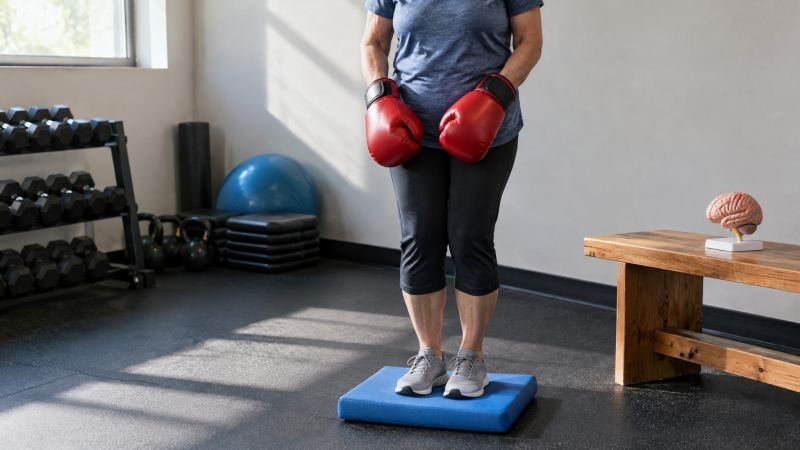
- Visual, vestibular, and proprioceptive work. These drills train the systems that tell you where you are in space, how your head is moving, and where your limbs are without looking.
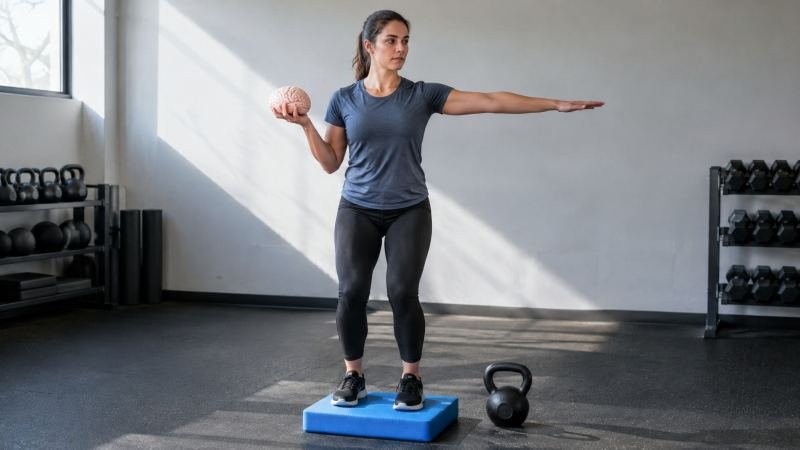
- Cerebellum-centric drills. The cerebellum helps coordinate timing and smooth movement, so these exercises emphasize precision, sequencing, and rhythm. Here is a closer look at cerebellum-focused balance drills.
- Cross-body movement patterns. Punching combinations, rotation, and opposite-arm, opposite-leg work ask both sides of the brain and body to cooperate.
Boxing is a good vehicle for these pillars because it is rhythmic, engaging, and demands attention. You are reacting and thinking, not just repeating a movement.
Parkinson's PT vs. Exercise Coach: How Goals and Methods Differ
In short, PT is aimed at impairment, safety, and function. Boxing-based training is aimed at capacity, skill, and consistency. Both matter, and they ask for different things from you.
Physical Therapy vs. Boxing for Parkinson's: Goals Side by Side
| Physical therapy | Boxing-based coaching | |
|---|---|---|
| Goal | Address impairments, reduce fall risk, restore safe function | Build capacity, coordination, confidence, and a training habit |
| Method | Clinical evaluation, targeted exercises, approaches such as LSVT BIG | Footwork, rotation, rhythm, reaction drills, and cross-body patterns |
| Who designs the plan | A licensed therapist, in a written plan of care | The coach, based on assessment and your clearance |
| How progress is measured | Clinical measures tied to plan-of-care goals | Skill progression, session consistency, and how you feel and move |
| Typical setting | Clinic, hospital, or your home | Training studio, gym, or group class |
The table simplifies things, and real programs blur the edges. A good therapist builds confidence, and a good coach watches safety closely. The core difference is who is responsible for what.
Coverage, Cost, and Who Is Accountable
Clinicians own the evaluation and the plan of care. That ownership is what makes PT medically necessary in the eyes of a payer, and it is why a therapist is accountable for clinical decisions in a way a coach is not.
Insurance often covers medically necessary PT, billed under that plan of care. Coaching is usually paid privately, and plan details vary, so you should ask your insurer what applies to you before you book.
You are not choosing between a covered option and an optional extra. You are choosing between a clinical service and a training service, and many people are better off using each for what it does well.
When to See a Neuro Trainer vs. a Physical Therapist First
A simple decision rule works better than a blanket verdict. If something about your movement is new, worse, or painful, evaluation comes before training. If your mobility has been steady and your clinician has cleared you, training can come first.
Clinical consensus in Parkinson's rehabilitation points the same way. A new change in walking, balance, or falls is a reason for a formal evaluation before you move into general fitness training.
Start With Physical Therapy When Movement Has Changed
These situations point to a PT evaluation:
- New or worsening falls or near-falls
- Freezing of gait
- Pain that changes how you walk or move
- Recent surgery or hospitalization
- A referral from your neurologist or another clinician
Any sudden change goes to your neurologist or primary care clinician before anything else. A sudden shift in how you walk or think can have causes that no therapist or coach should sort out alone.
If pain or balance is your main worry, this overview of exercise approaches for chronic pain and balance can help you frame the conversation with your clinician.
A Neuro Trainer Can Fit First When Mobility Is Stable
Sometimes a coach is a reasonable first step. That is true when your mobility is stable, your medical clearance is documented, and your goal is ongoing work on balance, coordination, and confidence.
This fits people who are active and steady but want structure, and people whose therapy ended while they still wanted somewhere to keep training. It also suits caregivers and care centers looking for an adaptive program for adults with special needs, as long as the participant's care team agrees.
This is not the right route for anyone who has recently fallen, who is freezing, or who has no clearance. In those cases, a coach is the wrong first call.
Boxing is also one format among several. If a group class is not what you want, you can compare other neuro-based coaching options before deciding.
Combining PT and Boxing for Parkinson's Without Overlap
When therapy and coaching run side by side, each one needs a clear lane. Therapy evaluates and treats. Coaching trains. Coaching is the training layer on top of therapy, never a substitute for it.
You will notice some overlap in range of motion, balance, and transfers. Both a therapist and a coach touch these, but for different reasons: the therapist is correcting or protecting, while I am building and reinforcing. If range of motion is a focus for you, these range-of-motion exercises for Parkinson's show the kind of movement both roles work with.
A Practical Sequence for Combining Both
The order that works best for most people looks like this:
- PT evaluation and baseline. Your therapist documents how you walk, balance, and transfer, and sets goals.
- A home program. You learn exercises that keep the gains going between sessions.
- Coaching built on that foundation. Your coach uses the baseline to choose drills, intensity, and safety limits.
- Periodic PT re-checks. A short return to your therapist confirms that nothing has slipped and the plan still fits.
Sharing the baseline matters. When I can see what your therapist found, I don't have to guess where your risks are.
Keeping Your Care Team Informed
Tell your therapist and neurologist that you are training, and tell them what you are doing. Then tell your coach about any changes in medication, symptoms, or health.
Certain warning signs send you back to your clinician before the next session:
- New falls
- Pain that changes how you move
- Any sudden decline
A good coach stops the drill and makes the referral. A good coach does not push through any of those.
Choosing a Parkinson's Boxing Coach: What to Check Before You Start
Not every boxing gym is set up for Parkinson's, and the label on the door tells you little. Ask any coach these questions before you sign up:
- Certification. Do they hold a neuro-training or Parkinson's-specific certification?
- Experience. Have they worked with people with Parkinson's, and for how long?
- Screening. Is there a screening step before the first session?
- Head contact. Does the approach avoid head contact entirely?
Understanding how a Parkinson's-focused class differs from regular boxing will help you spot a generic fitness class dressed up as something more.
Here is what I can state about my own background. I am a 6th-degree black belt and neuro-training specialist. I founded Texas's first Rock Steady Boxing affiliate. I work with Parkinson's clients as well as special needs adults, and I stay current through ongoing certification with the NeuroTraining Institute. You can read more about the Neuro Training Specialist credential, and if you are in Texas, Jeff's Texas Rock Steady Boxing affiliate is the local starting point for group classes.
Two red flags should end the conversation. One is any claim that boxing cures Parkinson's. The other is sparring for people with balance problems.
If you are weighing this now, contact Neuro With Mr. B and we'll talk through whether neuro-training fits alongside your current PT, neurologist, or care team. Bring your clinician's notes to that conversation, and we'll start from what they already know about you.
Frequently asked questions
Can I do Parkinson's boxing instead of physical therapy?
Boxing coaching is not a replacement for PT. A therapist evaluates and treats movement problems and writes a plan of care, while a coach builds skill, rhythm, and confidence. If your mobility is stable and you have clearance, coaching can come first, but a therapist should handle any new or worsening problems.
Does insurance pay for Parkinson's boxing coaching?
Insurance often covers medically necessary physical therapy billed under a plan of care. Coaching is usually paid privately. Plan details vary, so check with your insurer about what applies to you.
Do I need a doctor's clearance before starting a boxing program?
Yes, you should have documented medical clearance before you start. A good coach also runs a screening step before the first session. After any sudden change, talk to your neurologist or primary care clinician before you train.
Does Parkinson's boxing involve getting hit?
A well-designed program avoids head contact. The work centers on footwork, rotation, rhythm, and combinations, not sparring. Sparring for people with balance problems is a red flag when you vet a coach.
Is boxing proven to help Parkinson's?
The results are promising but not proven. Research on boxing-based training for Parkinson's is still largely small-scale. A coach should never describe it as a cure or as a substitute for medical care.
Neuro With Mr. B provides education and coaching, not medical diagnosis or treatment. For medical concerns, consult a qualified healthcare professional.