In this article
- What Adaptive Fitness for Adults With Disabilities Involves
- How a Special Needs Adult Fitness Program Is Built
- Balance and Coordination Coaching in Practice
- Group Fitness for Special Needs Adults: How Sessions Run
- Choosing a Special Needs Exercise Coach Near You
- Working With Caregivers and Care Centers
- Booking Your First Assessment
- Frequently asked questions
Search for a special needs adult fitness program near you and most of what comes back is a directory: a list of providers, hours and service categories. That tells you who exists. It doesn't tell you what happens when your son, sister or client walks into a first session.
This page does the second job. It explains how Jeff Battenberg, a sixth-degree black belt and neuro-training specialist, builds adaptive training for adults with disabilities. It names the drills, the logic behind them and what a coach should be tracking.
What Adaptive Fitness for Adults With Disabilities Involves
Adaptive fitness means the program bends to the adult, not the other way around. The goal, the pace, the spacing and even the wording of each cue are set by how that person moves, sees, hears and processes instructions.
A standard gym routine assumes a body that can already balance, sequence movements and copy a demonstration at speed. For many adults with disabilities, those are exactly the skills that need building, so a generic class either loses them or leaves them standing at the back.
Balance and coordination are the trainable core. Both depend on the brain and body talking to each other through the cerebellum, the vestibular system (the inner-ear balance sensors) and proprioception, the sense of where your limbs are without looking. Jeff's method holds that these inputs work together, so each drill targets one of them directly instead of repeating a fixed class plan.
Directories and local gym pages rarely get this specific. Many list "adaptive fitness" as a service line and stop there. Jeff's coaching blends martial arts, boxing and assessment-driven neurological drills, and that is the difference you can check for yourself: ask any coach which drill trains which system, and why.
This is not medical treatment, and it does not replace physical therapy or care from your physician. It is skilled movement coaching that works alongside them.
How a Special Needs Adult Fitness Program Is Built
Every program starts with the same three-part sequence: a baseline screen of balance and coordination, goal-setting with the adult and any caregiver, then drill progression. The order matters because the screen decides which drills come first, and the goals decide what counts as progress.
Nothing in the sequence is a fixed class plan. Two adults can begin on the same day and be doing different drills by week two.
Intake Assessment and Goal Setting
The baseline screen looks at how you stand, shift weight, turn your head, cross the midline of your body and recover when something shifts. It is quiet, unhurried work. The coach watches before deciding what to ask.
Goals come next, and they come from the adult first. A caregiver adds the daily context: stairs at home, trips in the community, the moment in the day when unsteadiness shows up. The best goals are small and visible, such as standing to brush teeth without gripping the sink, or walking into a room without scanning for something to hold.
Drills are chosen to hit the weakest input first, and each one has a clear way to be made easier or harder. Because the screen is repeated, the coach compares like with like and sees whether the work is carrying over.
Balance and Coordination Coaching in Practice
Jeff organizes drills under named pillars: visual, vestibular and proprioceptive work; cerebellum-centric work; and cross-body patterns. Each pillar below states what it trains, gives one representative drill and shows how a coach scales it. When training at The Village Centers with our Neuro-Martial Fitness program, you will see the different pillars in action.
Balance Drills: Cerebellum, Vestibular, and Visual Training
The cerebellum fine-tunes movement as it happens. Cerebellum-centric drills ask for controlled, deliberate repetition, such as a slow heel-to-toe step along a line with a hand near a rail. A coach adjusts them by changing the width of the stance, the speed or how much the hand touches the rail. The step-by-step detail is in the cerebellum balance drills guide.
Vestibular and visual drills train the inner ear and the eyes to agree with each other. A typical one has the adult stand with feet apart, fix their gaze on a target at eye level and turn their head slowly side to side while the eyes stay locked on it. Some adults feel dizzy or uneasy doing this, so the coach starts with small head turns, a seat nearby and short rounds. More on this work is in the guide to vestibular training exercises.
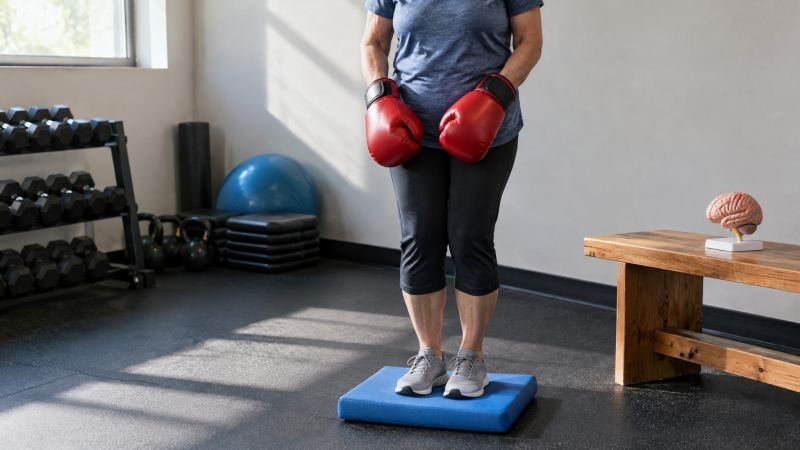
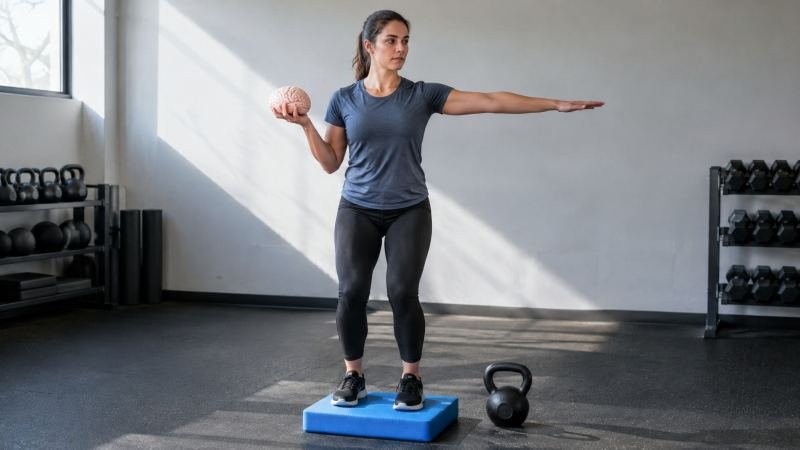
Proprioceptive work gives the feet and joints better information. Standing on different surfaces or shifting weight with eyes open, then with a softer visual reference, asks the body to rely on feedback from the ground. A coach reduces the challenge by returning to a firm floor and a wider base.
A typical progression looks like this:
- Begin with supported standing work, with both hands on a counter.
- Reduce the support to one hand, then to fingertips, then to none.
- Add head-turn variations once the stance is steady.
- Add cross-body reaches last.
- Change one variable at a time, so the coach knows exactly what caused a wobble.
That last rule is the one most programs skip. When speed, surface and head position all change together, nobody learns anything from the result.
Session to session, the coach tracks how long a position holds, how much support is needed, how smooth the recovery is and how the adult reports feeling. If you are a caregiver, these are the signals worth asking about.
Coordination Drills: Cross-Body Movement Patterns
Cross-body patterns make the left and right sides of the brain and body cooperate. The right hand reaches toward the left knee. The left foot steps while the right arm swings. These movements demand timing and planning, which is why they work as coordination training and not just exercise.
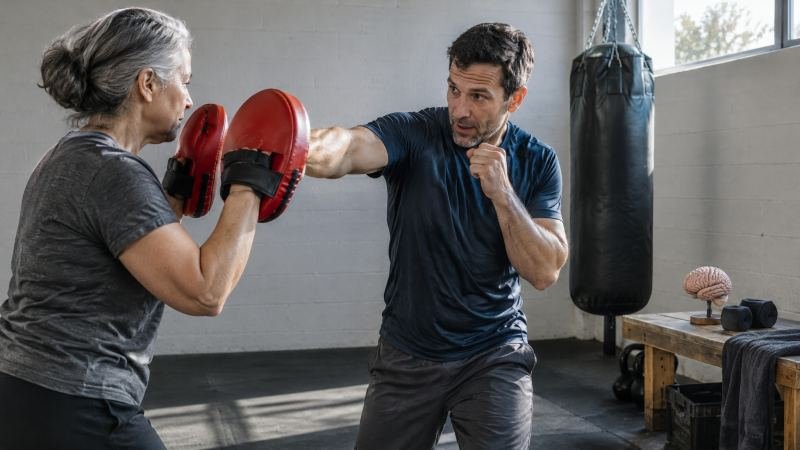
A representative drill borrows from boxing and martial arts: slow, shadow-style punches where each hand crosses toward the opposite target, called out one count at a time. Seated, it becomes alternating reaches to opposite knees. Standing, it adds a light step. The coach adds one element at a time, whether that is a step, a second target or a change in rhythm, and drops back a stage the moment the pattern breaks down.
What the coach watches is whether the movement stays smooth when a new demand arrives, and whether the adult can start it without a demonstration. More examples are in the cross-body coordination drills guide.
Group Fitness for Special Needs Adults: How Sessions Run
The Village Centers holds a group session, everyone working from the same drill list, but the delivery is individual: the coach changes cues, pacing and spacing for each adult while the class moves together. One person gets a verbal prompt, another a hand demonstration, a third more room to the wall or rail.
Group work also helps with confidence, because adults see their peers attempting the same drill and trying again after a stumble. Watching someone else wobble and recover is often what convinces an anxious adult that recovering is possible, and a room of people cheering a first unsupported step does more than any single coach's praise could.
Care centers that want to run this format can read the fitness program partner guide for care centers for how group sessions are organized.
Individual Sessions When Group Work Is Not a Fit
Group sessions are not the right fit for every adult. If noise, crowding or the need for constant one-to-one cueing keeps someone from taking part, individual sessions give the coach room to slow everything down. Some adults start one-on-one and join a group later, once the drills are familiar and the setting feels safe.
If you are unsure which format suits the adult in your care, the intake screen usually makes it clear.
Choosing a Special Needs Exercise Coach Near You
Proximity matters, but it is the least informative thing about a coach. A short drive to someone who runs generic classes will serve an adult worse than a slightly longer one to someone who assesses first.
Credentials Worth Checking
Jeff's background shows what a family can reasonably verify:
- A sixth-degree black belt, which signals decades of structured coaching and movement teaching.
- Neuro-training specialist status, with ongoing certification through the NeuroTraining Institute.
- Founder of Texas's first Rock Steady Boxing affiliate, which means he has built and run community programs for people with Parkinson's.
- Experience with special needs adults as well as Parkinson's clients.
You can ask any coach for the same details. Ask what the certification covers, whether it is current and who issued it. The page on the neuro-training specialist credential explains what to look for.
A credential alone does not guarantee a good fit for your family. It tells you the coach has trained in the subject, not that the style will suit the adult in front of them.
Questions to Ask Before You Book
Before committing, put these to any coach you are considering:
- How do you assess balance and coordination before choosing drills?
- Which drill would you start with for my family member, and what makes it easier or harder?
- What do you track from session to session, and how do you report it?
- How do you work with the adult's physician or therapist?
- What does a group session look like, and when would you recommend one-on-one instead?
A good coach answers these in specifics. If the replies stay at "we tailor everything to the individual," keep looking.
Working With Caregivers and Care Centers
Caregivers know things the screen cannot show in a single visit. Before the first session, share the adult's goals, relevant medical history and any medication or mobility aid that affects balance, such as a walker, a brace or a medication that can cause dizziness or drowsiness. Those details change which drills come first and how closely the coach spaces the work.
Care centers are asked for the same information, plus how sessions fit into the daily schedule and who will be present on the floor.
With your permission, the coach can coordinate with the adult's physician or therapist, so the movement work supports whatever else is going on in their care. Updates then reach you in plain terms: what was practiced, what improved, what needs support and what comes next. The caregiver guide to adaptive fitness covers what to expect in more detail.
Booking Your First Assessment
The first step is an initial assessment for the adult. If a caregiver helps with daily routines, bring them along, because their view of an ordinary day shapes the goals and the first drills.
Use the booking or contact step on this site to request a time.
Frequently asked questions
Is adaptive fitness the same as physical therapy?
No. Adaptive fitness is skilled movement coaching that builds balance and coordination through drills, and it does not diagnose or treat a condition. It works best alongside the care the adult already receives from a physician or therapist.
Can an adult with limited mobility take part?
Yes. Drills start where the adult is, including seated and supported standing work, and the coach reduces support or adds challenge one variable at a time. The intake screen sets the starting point, so no one needs a particular level of fitness to begin.
Should my family member join a group or start with individual sessions?
Group sessions suit adults who can handle shared space and benefit from watching peers. Individual sessions suit adults who need constant one-to-one cueing or who find noise and crowding overwhelming. Some adults begin one-on-one and move into a group later.
What should a caregiver bring to the first assessment?
Bring the adult's goals, relevant medical history and any mobility aid or medication that affects balance. A caregiver's description of a typical day helps the coach choose goals and first drills.
How will I know the training is working?
The coach repeats the baseline screen and tracks things like how long a position holds, how much support is needed and how smoothly the adult recovers from a wobble. You receive updates on what was practiced, what improved and what comes next.
Neuro With Mr. B provides education and coaching, not medical diagnosis or treatment. For medical concerns, consult a qualified healthcare professional.