In this article
- Why Assessment Must Precede Vestibular Drills
- Foundational Gaze Stabilization Exercises for Adults
- Integrating Proprioceptive Exercises for Adult Balance
- Visual Vestibular Training Through Dynamic Movement
- Dosing and Timeline for Vestibular Retraining
- When to Seek Professional Neuro-Training Support
- Safety Modifications for Neurological Populations
- Frequently Asked Questions
Vestibular training exercises for adults get mistaken for generic balance work all the time. Effective neuro-training isn't that. It requires precise targeting of the visual, vestibular, and proprioceptive systems. When dizziness or imbalance comes from a neurological condition like Parkinson's disease, standard fitness routines usually fail, because they never touch the underlying sensory integration deficit. Real adaptation only happens when the drills match your specific dysfunction instead of a one-size-fits-all protocol.
That distinction is what separates clinical rehabilitation from the assessment-driven coaching model at Neuro With Mr. B. Jeff Battenberg combines elite martial arts pedagogy with certified neuro-training to bridge medical therapy and functional performance. Here's how vestibular retraining works when you coach it as a skill rather than manage it as a symptom.
Why Assessment Must Precede Vestibular Drills
Trying vestibular training exercises for adults without a baseline evaluation isn't just ineffective. It can actively reinforce the compensatory patterns that make dizziness worse over time. Your nervous system adapts to whatever stimulus you give it, so practicing the wrong drill simply entrenches the wrong neural pathway.
The Risk of Generic Balance Protocols
Most balance programs treat instability as one uniform problem. The root cause varies a lot between people. One person may have degraded inner ear function. Another struggles with visual processing, or with proprioceptive feedback from their feet. Running identical exercises across these different deficits ignores the specificity that neurological adaptation actually requires.
Generic protocols also skip intensity regulation, which neuroplastic change depends on. Without knowing your threshold for symptom provocation, you either under-dose the stimulus or trigger a severe autonomic response that stops progress cold. Safety here means matching the challenge to your current capacity, and that's not something you can guess at.
How Jeff Battenberg Evaluates Visual-Vestibular Integration
Jeff Battenberg applies his 6th-degree black belt and NeuroTraining Institute certification to customize these clinical parameters for Parkinson's and special needs adults. His evaluation goes beyond a standard orthopedic screening and tests how well your eyes, inner ear, and body position sense work together under dynamic conditions. He identifies whether the primary limitation is gaze stability, head movement tolerance, or postural control during complex tasks.
The assessment sets a safety baseline before any exercise begins. By pinpointing the exact system failure, he makes sure the vestibular training exercises that follow target the real bottleneck instead of guessing at symptoms. That diagnostic precision turns a vague complaint of unsteadiness into a set of training variables you can actually work with.
Foundational Gaze Stabilization Exercises for Adults
Gaze stabilization is the bedrock of vestibular rehab because it trains the vestibulo-ocular reflex directly, the reflex responsible for keeping your vision clear during head motion. General balance training for dizziness focuses on foot placement. These drills instead force the brain to hold visual fixation while vestibular input keeps changing.
Horizontal Head Turns with Fixed Target
According to Stanford Medicine, safe gaze stabilization means holding each head position for 2 to 3 seconds and repeating the movement 15 to 20 times per session. You fix your eyes on a stationary letter or object at arm's length and turn your head side to side, keeping the target perfectly still the whole time. That hold time is what gives the central nervous system the error signal it needs to recalibrate.
Speed matters less than accuracy here. Rush the reps and you skip past the neural processing window where adaptation actually happens, and the drill turns into meaningless calisthenics.
Vertical Head Movements and Breathing Resets
Vertical movements often provoke stronger symptoms than horizontal ones, because the canal orientations and the gravitational effects are different. You run the same fixed-target protocol while nodding up and down, keeping your breathing rhythmic to avoid autonomic escalation. Exhale on the downward phase. It helps regulate intracranial pressure and cuts nausea risk.
Many adults hold their breath without noticing during a hard vestibular task, and that spikes blood pressure and mimics dizziness on its own. A conscious breathing reset is both a safety valve and a metronome for keeping your rep tempo consistent.
Progressing Duration Safely
Start with sets of just 10 seconds and work gradually toward a minute, based on how you respond. The progression isn't linear. Some days your tolerance drops because of sleep, medication timing, or stress, and a neuro-coach tracks those swings to adjust your daily volume without pushing you into decompensation.
Progress depends entirely on whether you can hold form and manage symptoms within acceptable bounds. Push duration up before you're stable at the shorter interval, and you just reinforce poor motor patterns and delay real adaptation.
Integrating Proprioceptive Exercises for Adult Balance
Proprioceptive exercises for adults anchor the vestibular work, because they supply the somatosensory reference frame your brain needs to interpret head motion correctly. Without reliable input from your joints and muscles, even a perfectly functioning inner ear can't produce accurate spatial awareness.
Heel-to-Toe Standing and Walking Drills
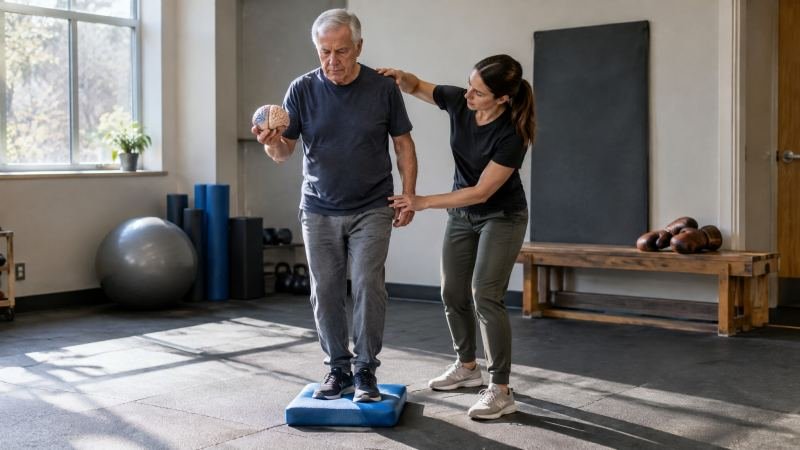
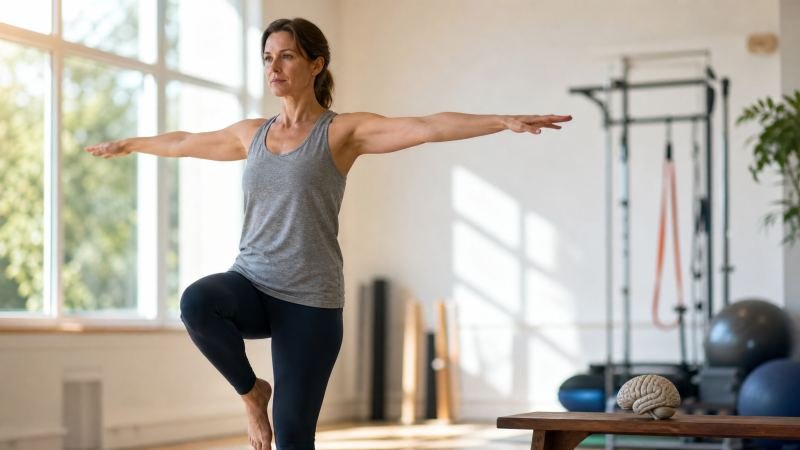
UMC Otology's patient handout puts the proprioceptive balance drills at a 30-second heel-to-toe standing hold and 5 minutes of continuous heel-to-toe walking. The narrow base reduces how much you lean on visual cues and forces your ankles to do the stabilizing work. Keep your hips level, and don't grab for support unless you genuinely need it to avoid a fall.
Walking drills add momentum and demand the anticipatory postural adjustments a static hold can't replicate. The five-minute duration builds endurance in the stabilizer muscles that tend to fatigue first in neurological populations.
Shoulder and Trunk Rotation Sequences
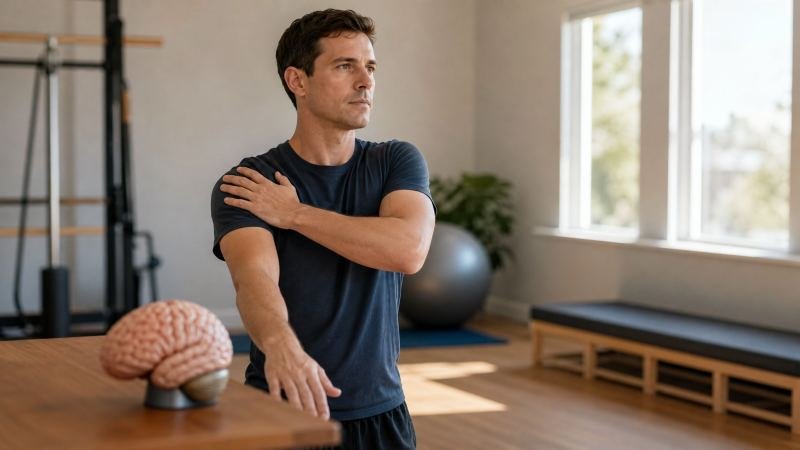
Rotational movement integrates the vestibular system with the axial muscles, which mirrors real-world demands like checking traffic or reaching behind you. You rotate your shoulders and trunk independently while holding your gaze forward, and that mismatch is what drives integration. The cross-body pattern engages cerebellar circuits that coordinated movement depends on.
Isolating trunk rotation from head movement teaches a dissociation skill that many Parkinson's clients lose early in disease progression. Relearning that separation cuts fall risk during transitional movements more than isolated limb exercises do.
Visual Vestibular Training Through Dynamic Movement
Static drills build capacity, but visual vestibular training eventually has to add locomotion, or the gains never transfer to daily life. Movement brings optic flow and variable terrain into play, challenging integration far beyond what a stationary exercise can test.
Walking with Head Turns
Walk 20 feet while turning your head 10 times back and forth, timing each turn to a step so the input stays rhythmic and predictable. The dual-task demand forces automaticity, because you can't consciously manage gait and gaze at the same time. The cerebellum takes both streams and produces smooth, adaptive output.
Dynamic training is what separates neuro-coaching from traditional clinical rehab: it goes after functional performance, not just symptom reduction. You learn to move through space with confidence instead of just tolerating head motion while seated.
Side-to-Side Target Tracking
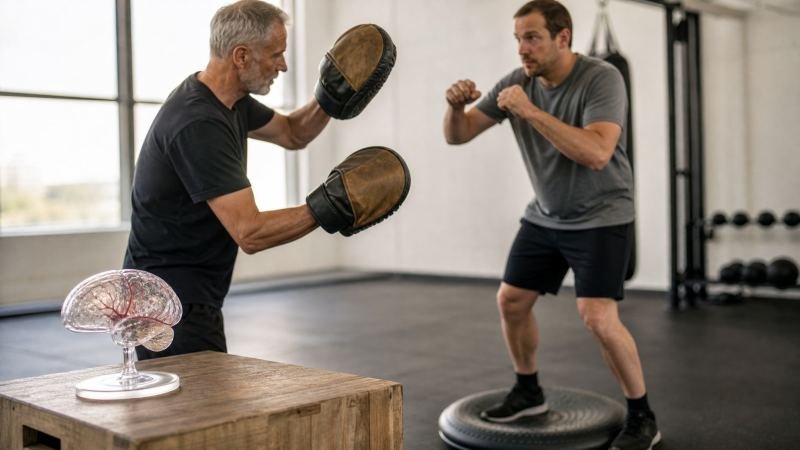
Tracking a moving target while walking laterally challenges smooth pursuit and the saccadic system under postural load at the same time. Follow a coach's hand or a pendulum while you sidestep, and your eyes, head, and trunk have to keep recalibrating against each other. It mimics real demands, like navigating a crowd or crossing a street safely.
Lateral movement gets skipped in most home programs, despite being one of the highest-risk directions for falls. Training it directly builds confidence in exactly the direction where neurological patients tend to feel least secure.
Dosing and Timeline for Vestibular Retraining
Neuroplasticity follows its own biological rules, and no amount of motivation speeds that up. Stanford Medicine's clinical guidelines call for vestibular exercises 3 times a day, for a minimum of 6 to 12 weeks, to resolve dizziness.
Consistency works as a coaching accountability metric here, not just a medical prescription. Miss sessions and the decay compounds, so each workout after that gets harder and less effective. Your coach tracks adherence to catch barriers before they derail the whole plan.
Results usually start showing up around week four, if the dosing stays consistent and properly graded. Earlier improvement is often compensation, not true neural adaptation, which is exactly why you keep going through the full 12-week window even after symptoms ease up early.
When to Seek Professional Neuro-Training Support
Home practice maintains gains, but it rarely starts significant neurological change without expert guidance. A few red flags mean you need supervised intervention instead of going it alone.
Signs You Need Guided Supervision
Severe nausea, vomiting, or symptoms that keep getting worse after exercise means the dosing is off, or the diagnosis is. Plateauing after three weeks of consistent effort means your current protocol has stopped giving you enough stimulus. Fear of movement or avoidance behavior points to a psychological barrier that needs coaching support alongside the physical work.
None of these resolve through sheer persistence, because they reflect either nervous system overload or insufficient challenge. Professional oversight adjusts the variables in real time and keeps you in the adaptation zone.
Booking an Assessment with Neuro With Mr. B
Book a personalized vestibular assessment to establish your baseline and get a training plan built around it. Jeff Battenberg's fusion of martial arts discipline and clinical neuroscience closes gaps that pure medical or pure fitness approaches miss. He founded Texas's first Rock Steady Boxing affiliate, and that experience shapes programming built specifically for neurological resilience.
The assessment tells you whether you're ready for independent practice or need ongoing coaching. Either answer saves you from wasting effort on exercises that don't match your deficit.
Safety Modifications for Neurological Populations
Safety in vestibular training comes from regulated intensity, not from avoiding movement. Per UMC's safety protocol, resting 30 seconds between repetitions lets symptoms resolve before the next bout of vestibular stimulation. That pause is what keeps cumulative overload from triggering a shutdown response.
Adults with Parkinson's or special needs may need longer rest intervals or fewer reps at first. Environmental modifications, corner positioning, chair backing, a spotter standing by, let you push intensity higher while keeping fall risk low. The goal is the maximum therapeutic dose within safe limits, not minimizing exposure to guard against harm that may never happen.
Symptom resolution comes down to a few tools: a seated recovery position, fixing on a focal point, and controlled breathing, applied the moment distress shows up. Learning those tools builds the kind of self-efficacy that carries past the training session into everyday navigation.
Frequently Asked Questions
What is the best vestibular exercise?
There is no single best exercise because effectiveness depends entirely on your specific deficit. Gaze stabilization works for vestibulo-ocular reflex issues, while proprioceptive drills address somatosensory loss. A professional assessment identifies which system needs training so you don't waste time on irrelevant movements.
How long does it take to retrain your vestibular system?
Clinical guidelines show meaningful adaptation requires 6 to 12 weeks of thrice-daily practice. Early symptom relief around week four often reflects compensation rather than true neural rewiring. Completing the full timeline ensures lasting change rather than temporary masking.
Can I do vestibular therapy on my own?
Home maintenance is valuable but initiating retraining safely usually requires professional assessment first. Self-directed practice risks reinforcing wrong patterns or missing the correct deficit entirely. Once properly programmed by a specialist, independent execution becomes safe and effective.
How do I reset my vestibular system?
You cannot instantly reset vestibular function; adaptation requires repeated calibrated stimulation over weeks. Specific drills like gaze stabilization provide the error signals your brain needs to recalibrate. Consistent dosing at appropriate intensity drives gradual neural plasticity rather than immediate correction.
Neuro With Mr. B provides education and coaching, not medical diagnosis or treatment. For medical concerns, consult a qualified healthcare professional.