In this article
- Why Standard Fitness Fails Tremor Management
- How Targeted Boxing Drills Address Tremor Symptoms
- Parkinson's Tremor Exercise Coach vs. Generic Boxing Trainer
- Reducing Tremors with Movement Training: Real-World Application
- The Neuro With Mr. B Methodology
- Starting Your Neuro-Boxing Assessment
- Frequently Asked Questions
Tremors do not respond to motivation or generic effort. When you live with Parkinson's disease, essential tremor, or another neurological condition, standard fitness advice often misses the underlying deficit driving your symptoms. You need a boxing coach for tremors who understands that shaking hands and unsteady gait stem from cerebellar and vestibular dysfunction, not just muscle weakness. Neuro-training bridges this gap with assessment-driven drills that force your brain to adapt instead of just exhausting your body.
Why Standard Fitness Fails Tremor Management
Most gyms treat movement as a calorie-burning activity rather than a neurological intervention. Cardiovascular health matters, but running on a treadmill or lifting weights does not touch the specific neural misfires causing your hand to shake or your balance to fail. Effective tremor coaching integrates your visual, vestibular, and proprioceptive systems at the same time, moving past simple repetition to challenge your brain's adaptive capacity. Skip that integration, and exercise stays a physical task that leaves the root cause of your instability untouched.
The Gap Between General Exercise and Neuro-Specific Training
General fitness assumes a functioning nervous system that merely needs strengthening. Your nervous system needs recalibration, because the pathways governing rhythm, timing, and spatial awareness have degraded. A specialized program targets these deficits directly, using unpredictable stimuli that demand real-time processing. That distinction separates symptom management from mere physical maintenance.
How Targeted Boxing Drills Address Tremor Symptoms
Boxing is a unique therapeutic tool because it combines complex motor planning with high-intensity output in a safe setting. The sport demands that you process external cues while executing precise movements, and that combination creates the exact conditions neuroplasticity needs. A drill designed to reduce tremors with movement training changes faster than your habitual patterns can take over, so you cannot zone out during a session. That constant demand for adaptation is what drives functional improvement.
Cerebellum-Centric Rhythm and Timing
The cerebellum regulates coordination and smooths out voluntary movement, which makes it a primary target for anyone seeking exercise for hand tremors. Drills built around cadence and temporal prediction force this region to engage actively instead of leaning on compensatory strategies. Specific cerebellum exercises for balance use rhythmic auditory and visual pacing to rebuild the internal timing mechanisms tremors disrupt. Restoring that internal metronome helps stabilize limb movement during training and during daily tasks.
Visual-Vestibular Integration in Punch Combinations
Your eyes and inner ear have to work together to maintain stability while your head and body move through space. Punch combinations that require tracking a moving target while shifting weight challenge this integration directly. According to an ABC11 report on a Cary gym class, local specialized boxing classes have helped patients fight Parkinson's by tailoring fundamentals to symptom management rather than general fitness. These integrated drills prevent the sensory mismatch that often triggers dizziness or loss of balance in neurological populations.
Cross-Body Patterns for Neural Recalibration
Tremors and rigidity often hit one side of the body harder, creating asymmetrical movement habits that reinforce neural dysfunction. Crossing the midline forces communication between the left and right hemispheres, which promotes bilateral integration that static exercises cannot achieve. Working cross-body coordination drills into your routine challenges your brain to synchronize opposing limbs under load. That synchronization is essential for reducing tremors with movement training, because it rebuilds the cooperative neural networks disease has disrupted.
Parkinson's Tremor Exercise Coach vs. Generic Boxing Trainer
A personal training certification does not prepare a coach to manage neurological fatigue or cognitive overload. You need a Parkinson's tremor exercise coach who can tell the difference between muscular failure and neurological shutdown, and who adjusts intensity before safety is compromised. Understanding the differences between Rock Steady and regular boxing shows why clinical oversight matters more than athletic pedigree here. Safety depends on catching subtle signs of decompensation that a standard trainer would mistake for laziness or poor form.
Assessment-Driven Programming Over Generic Rounds
Every session starts with an evaluation of where you are that day, not a pre-written template. Tremor severity swings hour to hour with medication cycles, sleep quality, and stress, so programming has to stay fluid. Your coach adjusts drill complexity and duration in real time based on your balance feedback and processing speed. That responsiveness keeps training therapeutic instead of letting it become another source of physiological stress.
Safety Protocols for Balance and Cognitive Load
Neurological conditions impair the automatic postural adjustments that keep most people upright during dynamic movement. Coach-led routines built on unpredictable stimuli, rather than static exercise, are described as helping reduce stiffness and improve gait in seniors, but only when the right safeguards are in place. Non-contact formats remove the risk of head trauma while still allowing maximum intensity, so fear of falling never has to limit your neurological engagement. When motor execution degrades, your coach simplifies verbal instructions to manage cognitive load, which heads off the frustration that leads to early dropout.
Reducing Tremors with Movement Training: Real-World Application
Gym performance means nothing if it doesn't translate to independence outside the facility. The point of boxing for essential tremor or Parkinson's is to restore your ability to do fine motor tasks and cross uneven terrain with confidence. Neural adaptations forged under the pressure of a heavy bag have to eventually show up as steadier hands at the dinner table. That functional transfer only happens when drills mimic the multi-sensory demands of actual life.
Non-Contact Boxing for Essential Tremor and PD
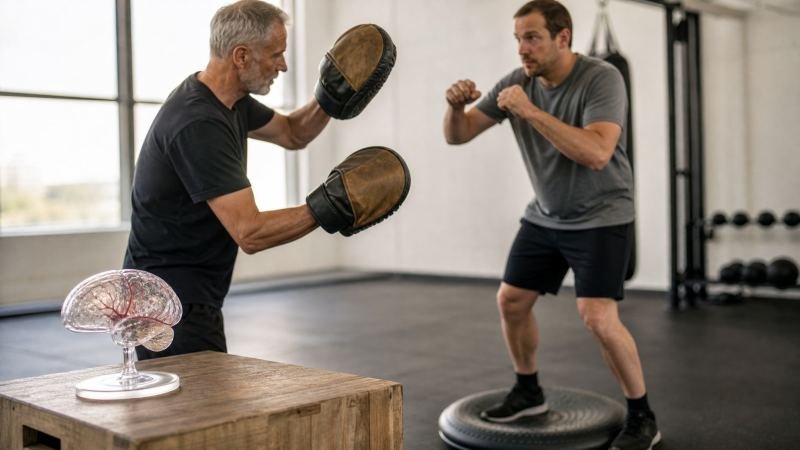
Striking pads and bags gives you all the neuromuscular benefit of boxing without the contraindications of sparring. Seniors and people with balance disorders can train at high intensity because the risk of concussion or injury from opponent contact is gone. This format lets you focus entirely on movement quality and neurological engagement instead of defensive survival. Non-contact training opens up aggressive symptom management to people who would otherwise be shut out of combat sports.
Translating Gym Gains to Daily Function
Holding a cup, buttoning a shirt, or signing a document calls on the same visual-motor integration you practice during combination punching. Training emphasizes proximal stability to enable distal mobility, which means core and shoulder control directly support hand function. Martial arts training for Parkinson's uses this kinetic chain principle so that power generation supports fine motor precision instead of overwhelming it. You practice stabilizing your torso while your extremities move fast, which mirrors the exact demands of self-care activities.
The Neuro With Mr. B Methodology
Effective neuro-rehabilitation takes more than good intentions. It demands technical mastery of both martial arts and neurological science. Jeff Battenberg founded Texas's first Rock Steady Boxing affiliate and holds certification through the NeuroTraining Institute, blending elite martial arts coaching with clinical neuro-rehab drills. That dual background means every drill serves a specific therapeutic purpose grounded in established neuroscience. His approach is the evolution of Rock Steady Boxing in Texas from a support group model into a clinically rigorous intervention.
Blending Martial Arts Precision with Neuro-Rehab Science
Traditional boxing coaching focuses on winning fights. Traditional therapy often lacks the intensity needed to drive neuroplastic change. This methodology fuses the discipline and technical precision of sixth-degree black belt instruction with evidence-based rehabilitation protocols. Drills target specific neural substrates responsible for tremor suppression and postural control, so you get the engagement of elite athletic coaching paired with the safety and specificity of clinical care.
From Rock Steady Boxing Founder to NeuroTraining Institute Certification
Decades working with neurological populations inform every program modification and progression. Ongoing education through the NeuroTraining Institute keeps coaching current with emerging research on visual-vestibular-proprioceptive integration. That commitment to continuing education is what separates specialized neuro-training from programs that coast on past achievements. Clients get a methodology that evolves alongside the science of neurological recovery.
Starting Your Neuro-Boxing Assessment
Your journey begins with a comprehensive evaluation, not a trial workout. This initial consultation establishes baselines for tremor severity, balance confidence, and cognitive processing speed to inform your custom training plan. You'll talk through your specific functional goals and medical history so programming matches your reality. Scheduling this assessment is the first concrete step toward reclaiming agency over your movement.
This approach does not cure neurological disease or replace medical treatment. It gives you a targeted, non-pharmacological tool for managing symptoms and maintaining function within the constraints of your diagnosis.
Frequently Asked Questions
Why does boxing help with Parkinson's?
Boxing combines complex motor planning, rhythmic timing, and visual-motor integration in ways that directly stimulate neuroplasticity. The sport demands simultaneous processing of external cues and precise physical execution, which challenges the cerebellar and vestibular systems impaired by Parkinson's. This multi-system engagement promotes neural adaptation more effectively than repetitive single-modality exercise.
What qualifications should a Parkinson's tremor exercise coach possess?
A qualified coach should hold specialized certification in neurological rehabilitation alongside martial arts or boxing credentials. They must understand medication cycles, recognize signs of neurological fatigue versus muscular failure, and modify drills in real-time based on symptom fluctuation. Clinical assessment skills matter more than athletic achievement when working with tremor populations.
Can non-contact boxing reduce stiffness and improve balance for seniors?
Yes, non-contact boxing reduces rigidity through high-amplitude, multi-planar movements that stretch shortened muscle chains while building strength. Balance improves because punching combinations require weight shifting and visual tracking under controlled conditions without fall risk. The absence of sparring allows seniors to train at therapeutic intensity safely.
Is it possible to be diagnosed with Parkinson's disease at 72 years old?
Yes, Parkinson's disease can be diagnosed at any age, and onset after 70 is actually quite common. Age remains the single largest risk factor, with incidence increasing significantly in each decade past 60. Late-onset presentations may progress differently than younger-onset cases but respond to similar neuro-training interventions.
Neuro With Mr. B provides education and coaching, not medical diagnosis or treatment. For medical concerns, consult a qualified healthcare professional.