In this article
- Why Rock Steady Boxing Texas Requires Neuro-Specific Coaching
- Meet Jeff Battenberg: Founder of Texas's First RSB Affiliate
- Neuro-Training Fundamentals Beyond Standard Boxing
- Visual and Vestibular Training for Balance Recovery
- What Your First Parkinson's Boxing Session Looks Like
- Adaptive Fitness for Special Needs and Neurological Conditions
- Enrolling in a Rock Steady Boxing Affiliate in Texas
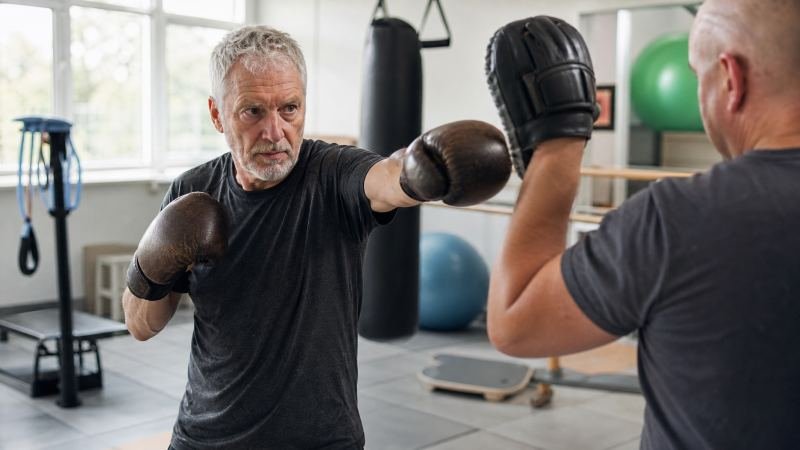
Search "rock steady boxing near me" and you'll mostly find generic fitness studios that treat Parkinson's as a secondary demographic, not a clinical focus. Cardiovascular exercise helps everyone. But neurological conditions need training built to rewire compromised pathways, not just get the heart rate up. Neuro With Mr. B works differently: it fuses elite martial arts discipline with clinical-style neuro-rehabilitation drills that target the cerebellum, the vestibular system, and proprioceptive feedback loops. That turns boxing into a targeted intervention for adults dealing with Parkinson's disease, special needs, or other neurological challenges who need more than sweat equity.
Why Rock Steady Boxing Texas Requires Neuro-Specific Coaching
Standard boxing classes raise your heart rate and build muscle tone. They don't address the sensorimotor deficits that neurodegenerative disease causes. If you want to reduce symptoms like freezing gait or postural instability, you need programming that understands the difference between general conditioning and neurological remediation. Generic fitness instructors offer encouragement and heavy bags. They typically don't have the assessment-driven framework needed to safely challenge a compromised nervous system, and pushing too hard without one can reinforce the very compensatory patterns you're trying to unlearn.
Neuro-training is different because every drill serves a diagnostic and therapeutic purpose, not just calorie burn. Assessment-driven neurological drills go into every session, so the stimulus matches your current processing capacity instead of overwhelming it. Martial arts precision meets rehabilitation science, and that combination lets high-intensity effort and cognitive safety coexist in the same session.
This methodology is not a replacement for medical treatment or physical therapy.
It's a bridge between clinical care and daily life, supplying the repetitive, high-engagement sensory input that medication alone can't. When you search for boxing for Parkinson's disease in Texas, check whether the program actually distinguishes between teaching someone to punch and teaching a brain to process spatial information under duress.
Meet Jeff Battenberg: Founder of Texas's First RSB Affiliate
Credentials matter when you're trusting someone with your neurological health and physical safety. Jeff Battenberg founded the first Rock Steady Boxing affiliate in Texas, combining elite martial arts coaching with clinical-style neuro-rehab drills after spotting a gap in care for the Parkinson's community. He's a 6th-degree black belt, which means decades of experience in biomechanics and kinetic chain efficiency, and his certification through the NeuroTraining Institute grounds that martial background in evidence-based neurological science.
That combination keeps instruction sharp on movement mechanics while staying compassionate about the daily reality of neurological conditions. Plenty of programs are run by well-meaning fitness professionals who learned about Parkinson's in a weekend workshop. This one was built on a lifetime of martial arts mastery adapted specifically for neuro-rehabilitation. As a 6th-degree black belt and NeuroTraining Institute certified specialist, Jeff builds assessment-driven neurological drills into every session.
You deserve coaching that respects both your diagnosis and your capacity to adapt. The goal has always been a space where clinical rigor meets real human connection, so that everyone who walks through the door gets guidance built around their own neurological profile.
Neuro-Training Fundamentals Beyond Standard Boxing
Cardiovascular endurance supports overall health, but it doesn't repair the neural connections Parkinson's or similar conditions degrade. The training pillars here include cerebellum-centric drills and cross-body movement patterns aimed at the specific neurological pathways Parkinson's affects, rather than just tiring out the muscles. These movements force the brain to communicate across hemispheres, which stimulates neuroplasticity in the areas responsible for coordination, timing, and motor planning.
Cross-body patterns require both sides of the body to move at once. That challenges the corpus callosum and sharpens the interhemispheric communication that fluid movement depends on. Cerebellum-centric drills focus on error correction and predictive processing, helping the brain recalibrate its sense of body position and momentum. These exercises can feel cognitively demanding even when they're physically manageable, because they tax processing speed, not just muscular endurance.
Repetition without cognitive engagement just reinforces old habits. Real neuro-training needs novelty and progressive complexity to keep the brain adapting instead of going on autopilot. That's what separates actual neurological rehabilitation from repetitive aerobic activity dressed up as therapy.
Visual and Vestibular Training for Balance Recovery
Falls rarely happen because of weak legs. They happen because the brain gets conflicting or delayed information about where the body sits in space. Visual and vestibular drills retrain how your eyes and inner ear work together to stabilize your gaze during head movement. When those systems fall out of sync from neurological decline, no amount of leg strength fixes the disorientation and postural collapse that follows.
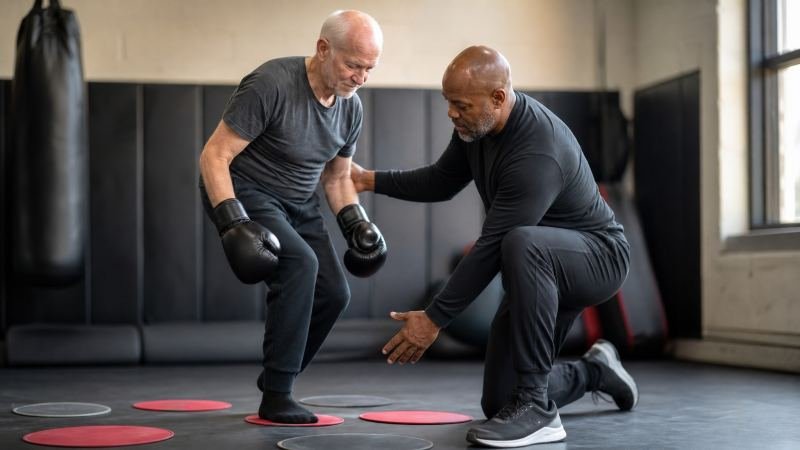
Before any corrective work begins, assessments identify whether your dizziness comes from visual dependence, vestibular hypofunction, or proprioceptive loss. Gaze stabilization exercises and dynamic visual acuity tests isolate the deficit, and from there the drills gradually increase sensory conflict in a controlled environment. This is far more effective at cutting fall risk than a generic balance board or a static standing exercise that never replicates real-world demands.
Your environment shapes your stability as much as your physiology does. Retraining these systems means exposing the brain to controlled instability so it learns to weight sensory inputs correctly again. Skip the sensory root cause, and balance training stays a temporary patch on a permanent processing error.
What Your First Parkinson's Boxing Session Looks Like
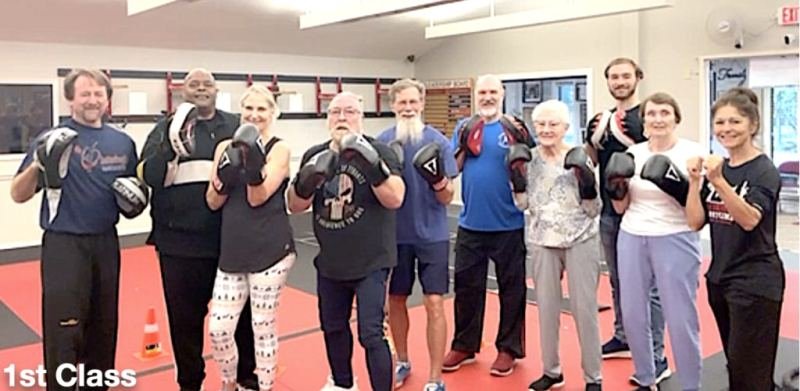
Anxiety about starting a new program is completely normal when you're managing a progressive condition. Your first session is mostly assessment, not exertion, so we can set a baseline and match safety protocols to what you can actually do right now. We check functional mobility, cognitive processing speed, and symptom triggers before you put on gloves, then build a plan around your limits and your growth edges.
Someone watches constantly for signs of autonomic dysfunction, fatigue-driven form breakdown, or cognitive overload that could lead to injury. Every drill has adaptive versions, so participants with significant mobility restrictions can engage right alongside those with higher function. You'll never be asked to do a movement that hasn't been scaled to your neurological presentation and comfort level.
That first consultation is also where we talk through your goals, fears, and medical history. Knowing your off-periods, your medication timing, and your non-motor symptoms lets us schedule sessions for when you're most receptive to learning. Booking that first appointment swaps uncertainty for a concrete plan built around what you actually need.
Adaptive Fitness for Special Needs and Neurological Conditions
Neuro With Mr. B serves populations ranging from Parkinson's clients to special needs adults, using adaptive fitness protocols that go beyond any single diagnosis. The same principles of neuroplasticity, sensory integration, and rhythmic cueing that help Parkinson's patients also help people recovering from traumatic brain injury or stroke, or living with cerebral palsy or developmental disabilities. Caregivers and care centers looking for rock steady boxing in Texas for non-Parkinson's populations will find programming that adapts to different cognitive and physical baselines.
Adaptive fitness here means meeting each participant exactly where they function today, without lowering expectations for progress. For some, success looks like better hand-eye coordination and less anxiety. For others, it means the confidence to navigate public spaces independently. Coaching adjusts in real time to behavioral cues, sensory sensitivities, and communication styles that standard gyms often miss or misread.
That inclusivity comes from understanding that neurological diversity needs flexible teaching, not just modified equipment. Whether it's a young adult with autism or a senior recovering from a stroke, the mechanism stays the same: structured, repetitive, engaging sensory-motor input drives adaptation. The program suits anyone whose nervous system responds to external rhythm and predictable challenge, whatever the label on their chart says.
Enrolling in a Rock Steady Boxing Affiliate in Texas
Finding the right rock steady boxing affiliate in Texas starts with checking whether the instructor is actually committed to neuro-specific methodology, not just generic fitness branding. Your next step is scheduling an intake assessment or consultation at Neuro With Mr. B to figure out fit and set baseline metrics. That first conversation carries no obligation. It's there to answer your questions, go over your medical context, and outline what a sustainable training schedule could look like for you.
Spaces stay intentionally limited to protect the quality of individual attention and safety oversight in every session. Contact us directly to talk about availability, pricing, and caregiver participation rather than relying on an automated booking system that can't account for neurological variability. Taking action today gets you a place in a community built around fighting neurological decline with expertise, compassion, and a real belief in human adaptability.
Neuro With Mr. B provides education and coaching, not medical diagnosis or treatment. For medical concerns, consult a qualified healthcare professional.