In this article
- What Parkinson's boxing classes in Texas involve
- Class format, schedule, and skill levels
- Neuro-training drills built into the boxing class
- Who teaches the class: Jeff Battenberg's credentials
- Your first Parkinson's boxing class, step by step
- Is boxing for Parkinson's in Texas the right fit for you?
- How to book a trial Parkinson's boxing class
- Frequently asked questions
Parkinson's boxing classes in Texas are group exercise sessions that use boxing footwork, punching combinations and reaction drills to train balance, coordination and confidence. Jeff Battenberg, a 6th-degree black belt and neuro-training specialist, coaches his classes under the Neuro With Mr. B name. They are built for adults with Parkinson's and other neurological conditions, and for caregivers or care centers looking for adaptive fitness options.
This page covers what a class involves, how levels work, what the first session looks like and how to book a trial.
What Parkinson's boxing classes in Texas involve
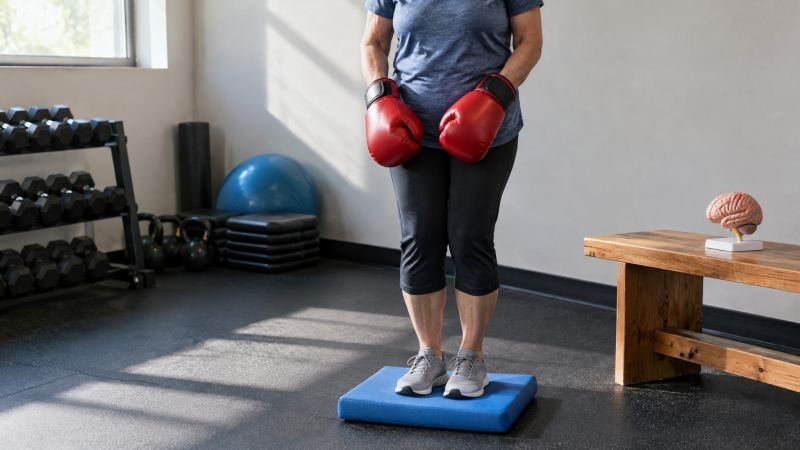
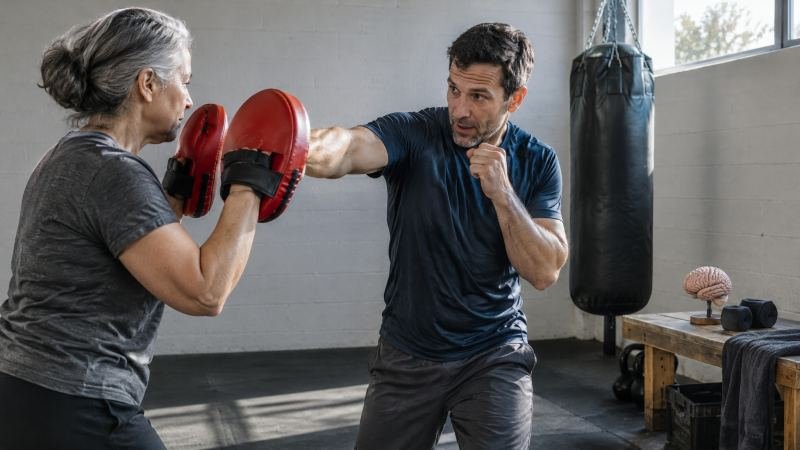
A class is a coached group workout. Participants throw punches at pads and bags, move their feet, react to cues and hold their balance while the hands are busy. The boxing is the vehicle. The goal is training the timing, posture and movement habits that daily life asks of you.
Nobody is there to win a round. You work at your own pace, and the coach adjusts the drill to the person in front of him.
Non-contact boxing for Parkinson's, explained
Non-contact boxing for Parkinson's means exactly what it says: no sparring, no head contact and no one trying to hit you. You punch pads, bags and targets, and you practise defensive movement such as slipping, weaving and stepping off a line without anyone throwing back.
That changes the whole feel of the room. A regular boxing class often builds toward sparring and conditioning that pushes athletes to exhaustion, while a non-contact class builds toward cleaner footwork, quicker responses and steadier balance during combinations. If you want a side-by-side, here is how a non-contact class differs from a regular boxing class.
Non-contact does not mean easy or passive. The drills ask for real effort and real concentration, and they are not a substitute for medical care.
Class format, schedule, and skill levels
Every session follows a sequence you can picture before you walk in. That predictability helps many people settle in, because you know what comes next even when the drills themselves are new.
Parkinson's boxing class schedule and group format
A typical Parkinson's group exercise class moves through four stages:
- Warm-up. Joint mobility, posture work and light movement raise your heart rate and wake up your balance system.
- Combinations. You learn short punching sequences, then string them together with footwork.
- Neuro drills. Gaze, balance and coordination challenges are woven in between boxing rounds. The next section covers them in detail.
- Cool-down. Slower movement and breathing bring everything back down.
The group format matters. You train alongside other adults who understand what it is like to move differently, and the coach can see everyone in the room at once.
Class times change, so the coach's current schedule is the only reliable source. Check it directly before you plan a visit, and ask which session suits your level and the time of day you usually feel your best.
Skill levels and how a newcomer is placed
Levels are defined by what you can do, not by your diagnosis stage or your age. Four questions guide the placement:
- Can you hold a stable stance, with or without support?
- Can you move your feet in a simple pattern?
- Can you respond to a verbal or visual cue without losing your place?
- Can you keep your balance while your hands are throwing combinations?
A newcomer who answers "not yet" to some of these is not turned away. The coach starts the drills at the level that person can do well, then builds from there.
Placement happens at the intake assessment, so you do not have to guess your level in advance. Your starting point is simply where the assessment says it is, and it moves as your skills do.
Neuro-training drills built into the boxing class
This is what separates the class from generic fitness. Jeff organizes the work around three named pillars, and he picks drills from an assessment rather than from a fixed routine. Two people in the same room may be doing different drills for good reasons.
One boundary applies throughout: these drills train movement skills. They do not treat Parkinson's itself, and they are not designed to relieve pain.
Visual, vestibular, and proprioceptive drills
Three sensory systems keep you upright and oriented, and this pillar trains all three.
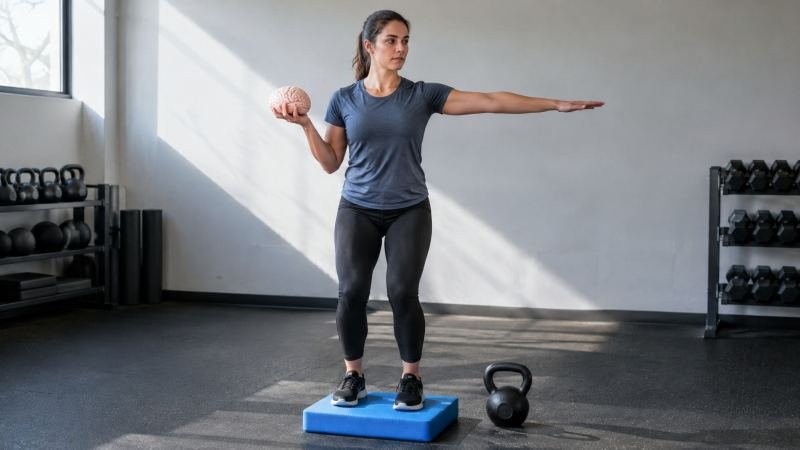
- Visual drills work on gaze stability: keeping your eyes steady on a target while your head or body moves, and shifting your gaze quickly between targets without losing balance. A pad that moves or a target that changes position gives your eyes something specific to track.
- Vestibular drills work on the inner-ear system that senses head position and motion. Head turns, changes of direction and balance on varied stances ask that system to keep your head and body coordinated. For more detail, see vestibular training exercises for adults.
- Proprioceptive drills work on joint position sense, which is your body's awareness of where your arms, legs and trunk are without looking. Punching to a specific spot, stepping to a marked position and changing surfaces all sharpen that feedback.
Each system supports the others. When one is weaker, the others have to compensate, so the coach tests them separately and then trains them together.
Cerebellum-centric drills and cross-body patterns
The cerebellum sits at the back of the brain and plays a central role in timing, coordination and balance. It helps smooth out movements and correct them as they happen. Cerebellum-centric drills lean on rhythm, precise targets and tasks that require you to time a movement against a cue. You can read more in cerebellum drills for balance.
Cross-body patterns pair opposite limbs, so the left hand works with the right foot, or one arm moves while the opposite leg steps. As an illustration, not a session transcript, a drill might ask you to step forward with your left foot while throwing a right cross, then reset and reverse it. These patterns ask both sides of the brain to coordinate, which is why they are a staple of the method. The guide to cross-body coordination drills goes further.
You will feel these drills as a challenge to your focus as much as your fitness. That is intentional.
Who teaches the class: Jeff Battenberg's credentials
Jeff Battenberg holds a 6th-degree black belt and is a neuro-training specialist whose coaching blends martial arts, boxing and assessment-driven neurological drills. His aim is better balance, coordination and cognitive function. He is in ongoing certification through the NeuroTraining Institute, and you can read what the neuro-training specialist credential involves if you want the detail.
His background also includes founding Texas's first Rock Steady Boxing affiliate. That is part of his history rather than a current affiliation, and Jeff Battenberg's Texas affiliate history tells that story.
Here is the short version of his credentials:
- 6th-degree black belt
- Neuro-training specialist, in ongoing certification through the NeuroTraining Institute
- Founder of Texas's first Rock Steady Boxing affiliate
- Experience with Parkinson's clients and special needs adults
Jeff is a coach, not a physical therapist or a clinician. He does not diagnose, and he does not replace your care team. What he brings is decades of martial arts skill and a method that treats balance, timing and coordination as trainable.
The people he serves are why the method exists. He works with adults whose bodies no longer cooperate the way they used to, and he wants them to leave class feeling more capable than when they walked in.
Your first Parkinson's boxing class, step by step
Walking into a new room is easier when you know the order of events. Your first Parkinson's boxing class follows a clear path.
- Arrival. You are greeted and introduced to the coach and the space.
- Intake assessment. The coach checks your balance, movement and responses to set your starting drills.
- Guided warm-up. You move through the warm-up with the group, at your own pace.
- First drills. You try your first combinations and neuro drills, scaled to your assessment.
- Debrief. You and the coach talk through what went well and what to work on next.
Intake and assessment before the first round
The assessment is what makes the first class different from a generic gym visit. Because drills are picked from what the coach observes in you, he cannot assign them before he has seen you move.
Expect simple tasks: standing, stepping, following a cue, shifting your weight. None of them is a test you can fail. They give the coach a map of where your balance, coordination and responses are strong and where they need work.
What to bring, wear, and tell the coach
Comfortable clothes you can move in and supportive, closed-toe athletic shoes with good grip are the right starting point. Bring water, and bring anyone who helps you get around if that is part of your day.
Tell the coach about three things before you begin. Recent falls matter because they shape which balance drills come first. Freezing spells matter because the coach can build cues around them. And your medication timing matters because how you feel often changes across the day.
Honesty here helps you directly. The more the coach knows, the better the starting drills fit.
Is boxing for Parkinson's in Texas the right fit for you?
Boxing is one good option among several forms of exercise for people with Parkinson's. It is not the best sport for everyone, and some people do better with walking programs, dance, cycling or one-on-one therapy.
The class suits adults with Parkinson's who want better balance, coordination and confidence, and who enjoy working in a group. It also suits caregivers choosing a program for someone else, including those who run care centers for adults with special needs. If you are in that second group, you can tell the coach about the person's abilities and routines at intake, and the drills will be scaled to them.
There is no fixed age or diagnosis-stage cutoff. The intake assessment tells you more than a number on a form, and it shows both of you whether this is the right starting point.
It is not for anyone hoping to compete, spar or get a medical treatment plan. For that last need, read boxing coach or physical therapy: which one you need. If you are still comparing options, a checklist for choosing a Parkinson's exercise program gives you questions to ask any coach, including this one.
How to book a trial Parkinson's boxing class
If you are looking for a Parkinson's fitness class in Texas and want to see whether this approach works for you, a trial class is the simplest way to find out. You get the intake assessment, a full session and a conversation with the coach, with no long-term commitment implied.
Booking steps and what to check first
Take these in order:
- Confirm the current schedule. Class times change, so look at the coach's latest schedule before you pick a day.
- Request a trial class. Send your request and say whether you are booking for yourself or for someone you care for.
- Check with your neurologist or physician. Do this before the first session, especially if you have had recent falls, balance problems, changes in medication or other health conditions. Your doctor knows your history and can flag anything the coach should plan around.
- Prepare your notes. Write down recent falls, freezing episodes and medication timing so you can share them at intake.
Skipping the medical check is the one step I would not recommend. The class is built to be safe, but it works alongside your care team and not in place of it.
When you are ready, check the current schedule and request your trial class with Neuro With Mr. B. Come and see what a session with a 6th-degree black belt and neuro-training specialist feels like.
Frequently asked questions
What is the best sport for people with Parkinson's disease?
No single sport is best for everyone. Boxing, dance, cycling, walking and swimming all help people stay active, and the right one is the one you can do safely and will keep doing. Boxing stands out for training balance, footwork and reaction time together, so it is worth trying if those are your goals.
Which boxer has Parkinson's disease?
Muhammad Ali is the best-known boxer with Parkinson's, and he was diagnosed in the 1980s. His case is also a reminder that the boxing in these classes is non-contact: no sparring and no head contact.
Is it possible to be diagnosed with Parkinson's disease at 72?
Yes. Parkinson's is most often diagnosed in later life, and a diagnosis at 72 is not unusual. A neurologist makes the diagnosis, and a coach cannot. Once you have one, you can ask your doctor about joining an exercise class.
What is the first thing to do if you have Parkinson's disease?
Work with a neurologist to confirm the diagnosis and plan your treatment. Ask them about exercise at the same visit. Once your doctor agrees, you can book a trial class and share your medication timing and any recent falls at intake.
Neuro With Mr. B provides education and coaching, not medical diagnosis or treatment. For medical concerns, consult a qualified healthcare professional.